Plasma cutting
This page is the reference for Plasma Profile, the one kind in the Plasma group of the operations ribbon. For the tabs themselves and what a click picks, see that page; for what a refusal means in general, see Reading a refusal.
Lengths are in mm (inches in an inch document), feeds in mm/min (in/min).
Blue shows the operation travel; dashed orange shows approach and retract; gray shows the workpiece. These schematics are not generated NC paths and have no scale.
The machine, the tool and the post
A plasma table. Plasma Profile needs a setup whose machine is a plasma table, such as the built-in Tormach 1300PL; a mill, lathe or mill-turn is refused ("a Plasma Profile operation is plasma cutting work; the setup's machine is a ... - mount a plasma table first"). A plasma table in turn takes no other kind ("... the setup's machine is a plasma table, which cuts only plasma operations (a Plasma Profile)").
A torch. The tool is a plasma torch, and its diameter is the kerf width. Anything else is refused ("a plasma profile mounts a plasma torch, not a ... - its diameter is the kerf width"); a torch states no rpm ("a plasma torch turns no spindle - its rpm must be 0 ...").
A plasma post. The Tormach PathPilot Plasma post serves plasma tables, and only them. The machine check judges X/Y travel and feed against the table, and refuses a spindle word, a tilted or turned move, or more tools than the table carries. Z is the torch lifter: the control sets pierce and cut height, so cutting depth and Z travel are not judged, and the 3D stock simulation does not run for a torch. The through-cut is judged instead by the plasma laws at the post gate (below).
Plasma Profile
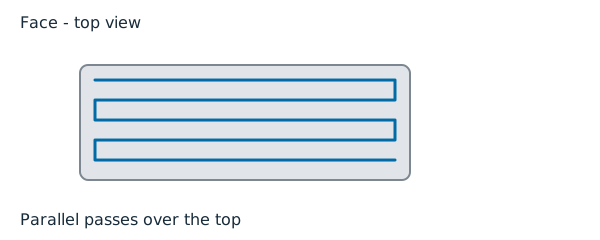

For: cutting parts out of flat plate: one through-cut per contour, with the kerf offset to the waste side, arc leads, holes before the outline that frees the part, and a slower centre-pierced cut for small holes.
Picks: the closed contours and open runs to cut, on the Geometry tab. Without picks it cuts the model's through-silhouette. A closed contour is cut with the kerf on the scrap side; an open run is cut on its centre line, with no kerf side and no leads.
| Tab | Setting | Default |
|---|---|---|
| Geometry | Kerf width | Torch: the torch's diameter |
| Geometry | Compensation | In computer (offset path); or In control (G41/G42) |
| Geometry | Direction | Outer CW, holes CCW; or Reversed: outer CCW, holes CW |
| Heights | Clearance (torch off) | 25 above the stock top |
| Heights | Top of plate / Bottom of plate | model top / model bottom |
| Heights | Pierce height / Cut height | Controller (blank) |
| Passes | Small hole below | 32 |
| Passes | Small hole feed | 65 % |
| Passes | Overburn | 0 |
| Lead in / Lead out | Lead-in length / Lead-out length | 5 / 3 |
| Feeds | Cut feed / Pierce delay | AutoFS (blank: the controller's material table) |
Kerf. The path is the torch centre: every lit move stands half the kerf off the part on the waste side. In control posts the part outline with G41/G42 and lets the control offset it; it needs straight leads at least the kerf radius long.
Direction. The default runs outer contours clockwise and holes counter-clockwise, so the arc's square edge falls on the part and the bevelled edge on the scrap. Reversed swaps both, and the path says so.
Leads. Arcs on the scrap side. A lead with no room beside the part is shortened, and the path names it ("lead-in shortened to ... mm - the stated ... mm found no room beside the part").
Small holes. A hole under Small hole below across, or under 1.5x the plate thickness, leads in from near its centre, takes no lead-out (the Overburn runs past the start instead) and is cut at Small hole feed of the cut feed.
Heights and feeds. One through-cut at the plate top; there are no depth steps. Blank heights, feed and pierce delay are left to the controller (AutoFS); a stated one must be positive ("a stated feed must be positive - leave it blank for the controller's").
The plasma laws. Generation refuses any lit move whose kerf would reach the part, and any edge the kerf can never reach. At the post gate, cut order and cut crossing refuse; a kerf crossing and a tip-up warn, named on the line:
- "contour C...: move ... would carry the kerf into the part near X... Y...
- refused";
- "contour C...: the torch never comes within a kerf of the part edge near X... Y... - a slot, notch or keyway narrower than the kerf (... mm) is bridged by the offset, not cut; widen it past the kerf or use a narrower kerf";
- "cut order: contour C... is cut after contour C..., which encloses it - a hole after its outline (or an island after its hole) cuts into a part already freed";
- "cut crossing: contour C...'s cut crosses contour C...'s - the kerf runs through a part already cut";
- "kerf crossing: contour C... comes within a kerf of contour C...'s cut - the torch height control can dive into the open kerf".
Common refusals: "plasma profile: no contour to cut"; "picked contour ... crosses itself - a cut path cannot cross its own kerf"; "picked contour ... has no area (a zero-length or collinear ring) - there is nothing to cut around"; "control compensation (G41/G42) needs a straight lead-in of at least the kerf radius (... mm) - the control builds the offset over it; the lead-in is ... mm"; "the clearance plane (...) must stand above the cut plane (...)"; "plasma profile: the plate's bottom (...) stands above its top (...)".